
Silenced
Facebook's silencing of a whistleblower shines a light on a private justice system and a "post-state" future where tech bros write the rules. Or as we call them, "laws"

A note on who I am: I’m an investigative journalist who’s spent a decade reporting on the collision of technology and democracy including exposing the Facebook/Cambridge Analytica scandal for the Guardian and the New York Times. Two years ago, I called the alliance of Trump, Silicon Valley and a global axis of autocracy: a tech bro oligarchy, aka the Broligarchy. Please help me continue to expose it.
Dear all,
Apologies for my absence. Thank you for bearing with me. I’ve been distracted by longer-term projects, the interconnected lines between global authoritarianism and Silicon Valley billionaires which underpin this newsletter.
One of those ongoing subjects is Peter Thiel and if you’re subscribing to this newsletter, I suspect you understand his importance and share that interest. I’ve been fascinated by his latest vessel, Javier Milei’s government in Argentina. The man who owns Palantir, embedded in the heart of America’s ICE apparatus, its AI war machine and Britain’s NHS, moved his family to Buenos Aires a couple of months ago…but what was he doing there?
I messaged Uki Goñi while pondering that, the Guardian’s former Argentinian correspondent who I’ve swapped notes with over the years. What I appreciate about Uki is his long experience of dealing with dictators. He’s not just lived through a dictatorship, he kept reporting throughout and when it comes to understanding the global far-right insurgency we are living through, I’ve always found him ahead of the game.
But, as we attempted to puzzle it out, Javier Milei, an “anarcho-capitalist” who campaigned with a chainsaw with which he promised to tear up the state (a pose, later appropriated by Elon Musk) solved it for us. Milei maintains a relationship with Musk and Trump and now Thiel and, posting on Twitter, he described a radical new policy that that he described as “AI MAGA”.
If you want to know what the future looks like, what Peter Thiel is planning, and what we should be paying attention to, it’s Argentina, Thiel’s latest plaything, host organism and testing laboratory.
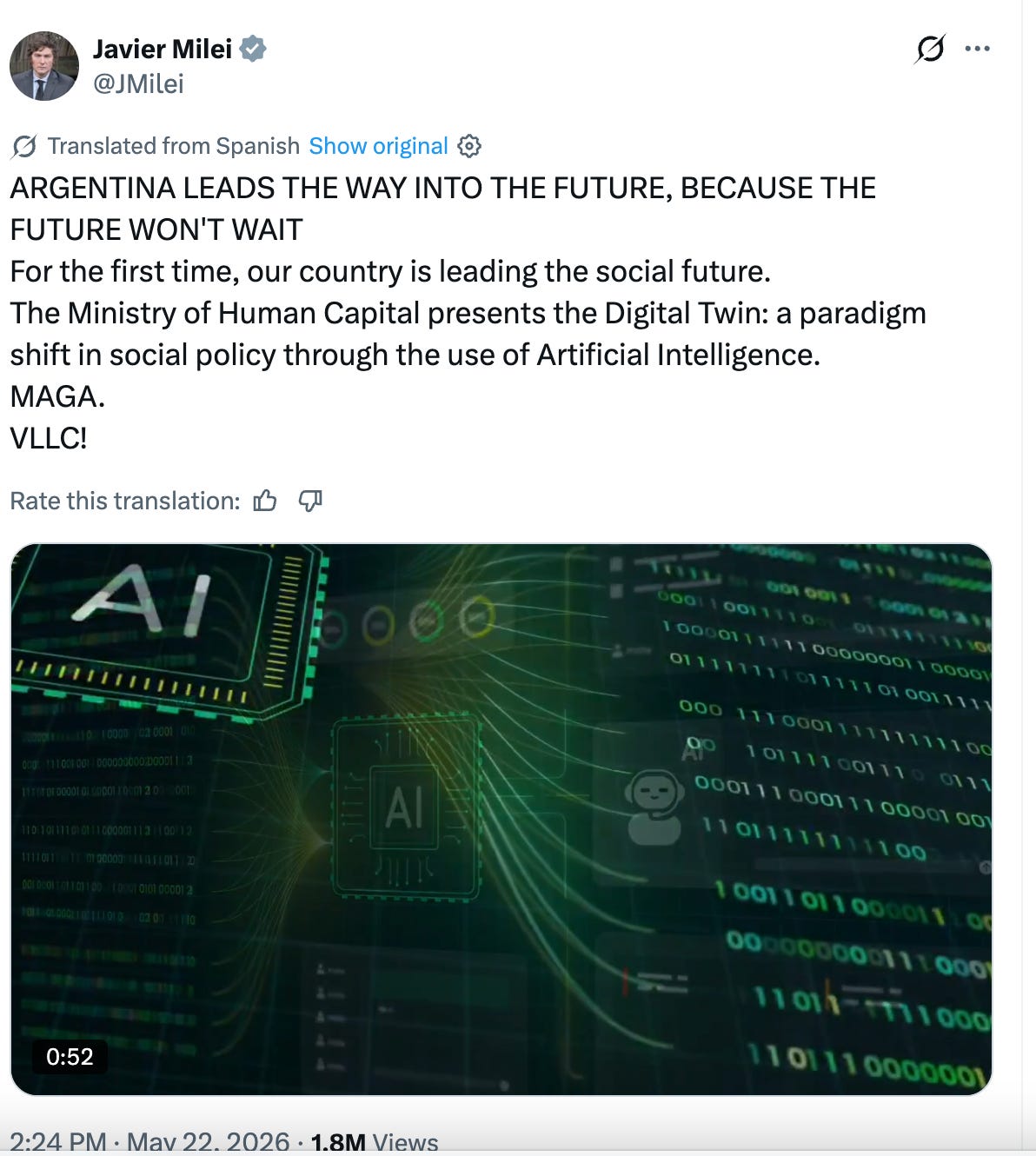
Two weeks later, Milei announced in the pages of the Financial Times that Argentina was inviting AI “to free itself” in Argentina. He was bringing in new legislation that would see Argentina become the first country in the world where an AI could own a company.
Peter Thiel is a believer in transhumanism. When he was interviewed the New York Times’s Ross Douthat, he hesitated for much longer than you’d think possible, when he was asked whether he wanted humanity to survive.
More on Argentina below including some words from Uki, and how he connects this to Argentina’s past, including its role as a refuge for Nazis who’d fled Germany.
First, a deeply connected question: what does it actually mean if corporations are more powerful than states?
I’ve been pondering that since I did an “interview” with Facebook whistleblower Sarah Wynn Williams earlier this month that blew up and made headlines across the world.
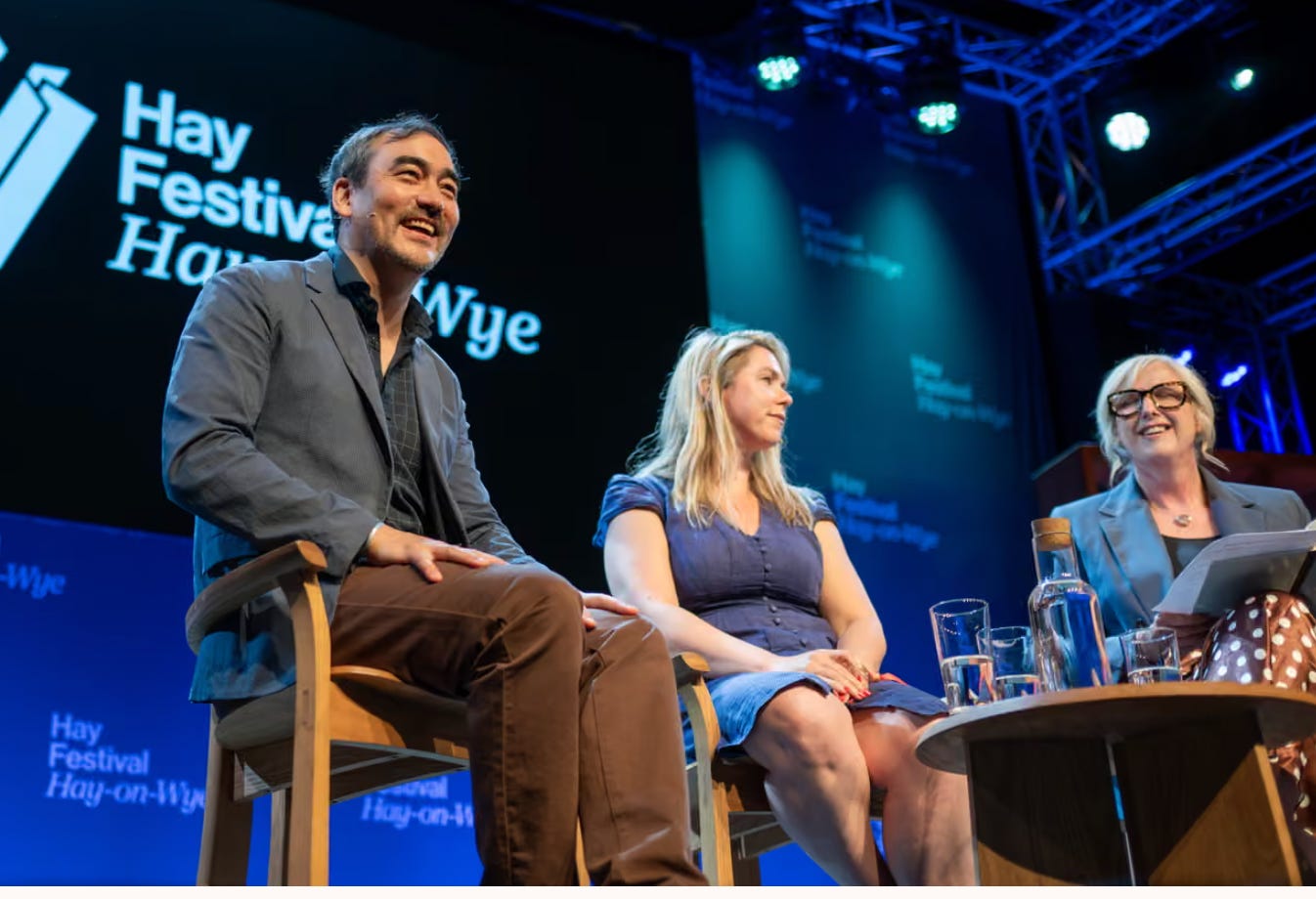
Wynn Williams is the author of the gossipy memoir of life at the top of Facebook, Careless People, and I’d been asked to interview her and the academic and writer, Tim Wu, at the Hay Festival, the daddy of all literary festivals in the green rolling hills of mid-Wales.
I wrote a short piece on what happened in the Nerve but there’s more to dig into. A day before the event was due to take place, I had a prep call with Wynn Williams but she came onto the Zoom and left almost immediately. “I’m not going to be able to speak,” she said. Why not? “I can’t tell you that either. You’re going to have to talk to my lawyer.”
As it happens, Wynn Williams’ lawyer, Ravi Naik, was at one time, my lawyer. He also represented David Carroll, the New York professor who tried to get his data back from Cambridge Analytica and whose story was followed in Netflix’s The Great Hack, a documentary about the scandal that I also appeared in.
There was something very familiar about talking to Ravi about a very familiar big tech company behaving in an all too familiar way. Last week saw the ten year anniversary of the Brexit vote, the inciting incident that precipitated my years-long investigation into the platform and the bad actors who weaponised it and what was fascinating to me about Wynn Williams’ book was not just what was in it - the details of working closely with Mark Zuckerberg and Sheryl Sandberg - but what wasn’t.
Wynn Williams was inside the company, operating at its highest echelons, when Cambridge Analytica harvested 87 million people’s personal data, when Facebook first discovered it had done so, and when the first article was written about it (by the Guardian’s Harry Davies).
She was there when I began reporting on it. And when Facebook lied to me in its responses to my press inquiries. That’s not hyperbole. One of the many investigations that the Cambridge Analytica scandal triggered was undertaken by the Securities and Exchange Commission. It fined Facebook $100m for misleading shareholders and among the aggravating behaviour it noted was its lies to journalists - that included me.
There is nothing about Cambridge Analytica in the book, an omission I find curious. The fallout from the scandal continues to this day. There are still ongoing lawsuits, Zuckerberg has been deposed multiple times to answer questions on what the executives knew when and exactly if and how they deliberately misled shareholders. These are multi-million dollar questions still and I do wonder if my particular presence next to Wynn Williams posed a particular threat to the company and may have contributed to what happened next.
Ravi explained that Facebook was threatening Sarah with punitive damages if she spoke at the event. It was suing her under the terms of an NDA that she signed as part of a severance deal. That enabled it to take her to an arbitration court - a private tribunal - where an arbitrator had granted it a temporary order that banned her from promoting the book and making “disparaging, critical, or otherwise detrimental comments” about the company.
The plan had been that she, Tim and I would talk about big tech generally, not the specifics of the book, but Facebook had got wind of it and written to her warning her that participating in the event in the presence of a “Carole Cadwalladr, an investigative journalist best known for her criticism of Facebook” and “another known critic” would put her in breach of the temporary order.
The solution, she’d decided, was to appear but not to speak.
Predictably, Facebook’s actions backfired. I described her on stage as “an author in a hostage situation” and the resulting spectacle was reported across the media.

It was petty and vindictive and Wynn Williams’ solution was a spectacular bit of political theatre that highlighted the ridiculousness of the act.
I’ve been mulling over the deeper meaning of that event and what Facebook did and was struck by this headline and report in Axios last week:

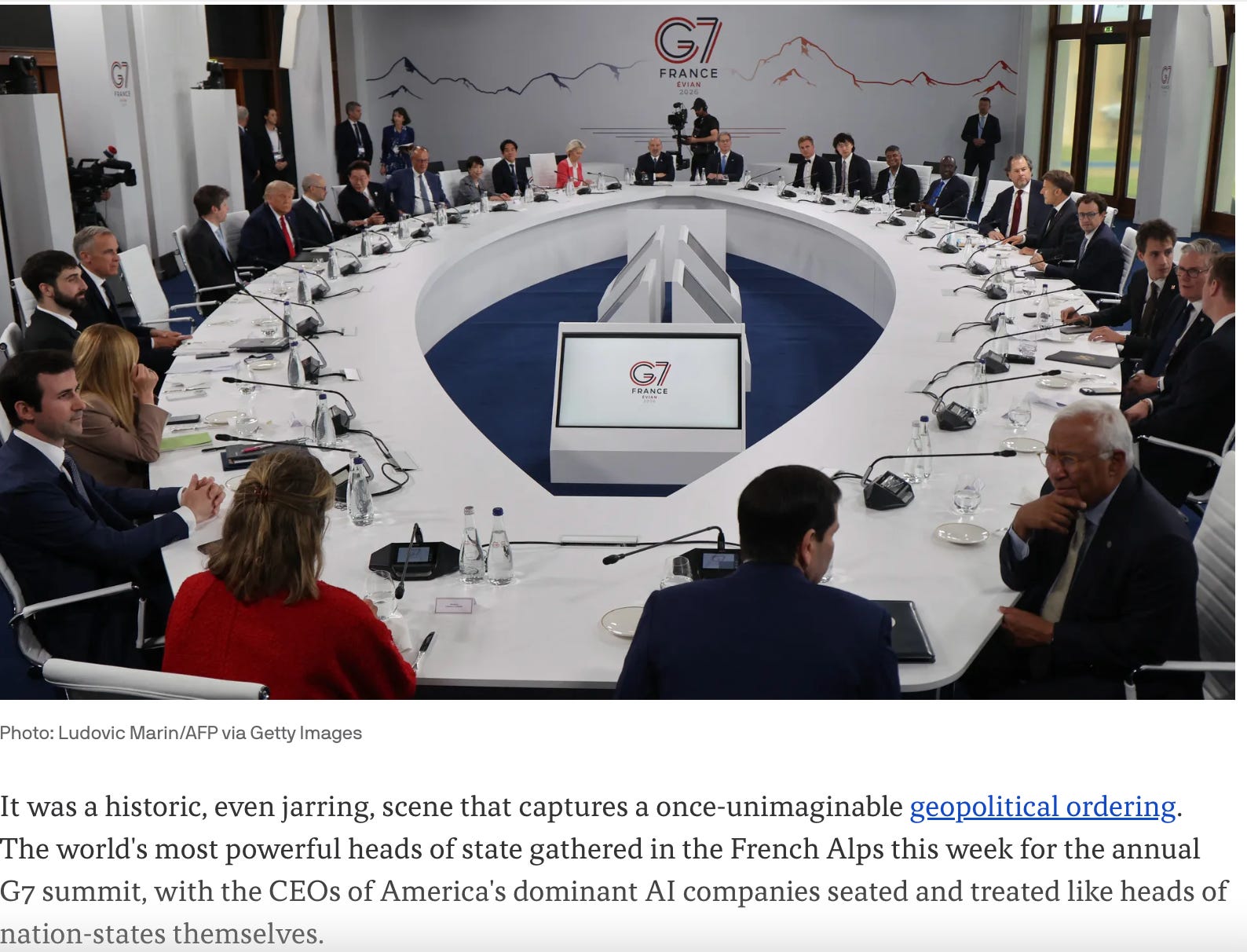
Big tech companies acting like nation states is what many people, myself included, have been saying for many years but what makes this stand out is that it’s not coming from any of us. It’s Axios, a business-friendly news site and the headline and the report are simply statements of fact.
The leaders of US AI companies now have - quite literally - a seat at the table. In the photo above, President Macron, the G7 host, is seated next to Anthropic’s CEO, Dario Amodei, while Trump has Sam Altman on one side and Google DeepMind CEO, Demis Hassabis, on the other.
And it’s in this context that we need to consider Facebook’s behaviour. In my view, its threatened retribution against Wynn Williams was performative, a punishment beating deliberately designed to deter future whistleblowers, but Wu had gone further. He’s a pretty cautious, legally precise academic and he used the word “authoritarian”.
Again, this is not hyperbole. Wu, a professor of law at Columbia, is one of the most authoritative experts on Silicon Valley monopolies. He has also been on the frontline on trying to find ways to regulate them including as a tech advisor to the Biden White House and inside the Federal Trade Commission.
And it’s what he wrote afterwards, in the Guardian, that has stayed with me.
“Were this a book about time spent in government, it is clear that free speech principles would protect the author’s right to speak (at least about unclassified matters). But because her book is critical of a private company – and because, as an employee, she signed standard agreements banning ‘disparaging, critical or otherwise detrimental comments’ – Meta is in a position to punish its critic and deter anyone else who may dare to speak against it."
“We live in a time when the power of private firms is regularly compared to nation states. Why, therefore, allow the legal system to become a party to corporate censorship? Look past the legal niceties and we are, in essence, granting corporate CEOs – in this case, Mark Zuckerberg – the kind of censorial prerogative usually sought by authoritarian leaders.”
It’s the comparison that struck me. If Wynn-Williams worked inside the Trump administration, this wouldn’t be possible. Her rights would be protected. We accept the idea of corporate NDAs as commonplace, a cost of doing business, but Wu makes an important point about what that means. And especially what that means when we’ve reached a place where even the G7 nation states are treating these companies on an equal footing.
But the saga doesn’t end there.
To say that Facebook’s stunt backfired is to put it mildly: the ensuing media storm saw her book sales increase by 305%.
And on Thursday, another shot was fired. This time by Wynn Williams. She’s now suing Meta. And in the court documents - flagged on Twitter by my friend and indefatigable tracker of Big Tech lawsuits, Jason Kint - it reveals that Facebook wrote to her after the event. Among its complaints was that it found my and Tim Wu’s response “disparaging”.
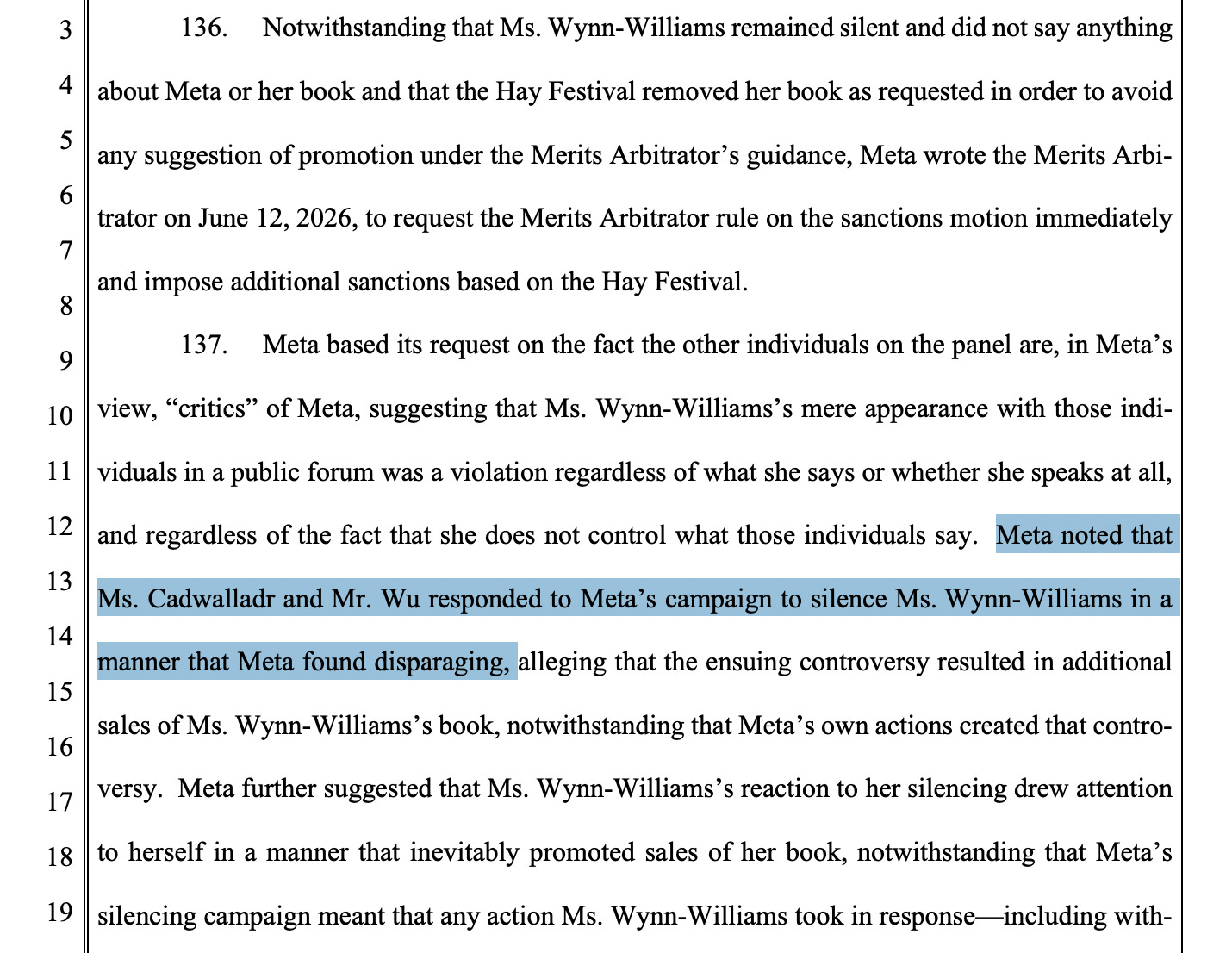
Well, yes, doh. That was exactly the point.
Gangster courts and a parallel world order
Facebook’s use of an arbitration court to silence Sarah Wynn Williams is not an accident. There’s no shortage of courts in either the US or UK, where Wynn Williams now lives. Criminal courts to try criminal cases and civil courts to settle business and other disputes.
But arbitration courts are an entirely parallel system. It’s commonplace for Silicon Valley companies to force them as a procedure for settling disputes not just in severance agreements but in joining agreements. Almost everyone who goes to work for a social media platform signs a contract on joining that prevents them from ever disclosing confidential information about what happens inside the company before they’ve even started their jobs.
It’s one reason why vanishingly few people have ever spilled the beans. The other is that they’ve drunk the kool aid/had their mouths have stuffed with gold/been so deeply compromised they’re in a state of denial or in Nick Clegg’s case all three.
It’s an ongoing source of pain to me that the former deputy prime minister and latterly Facebook’s head of policy and spin, is considered a plausible voice on anything to do with Silicon Valley.
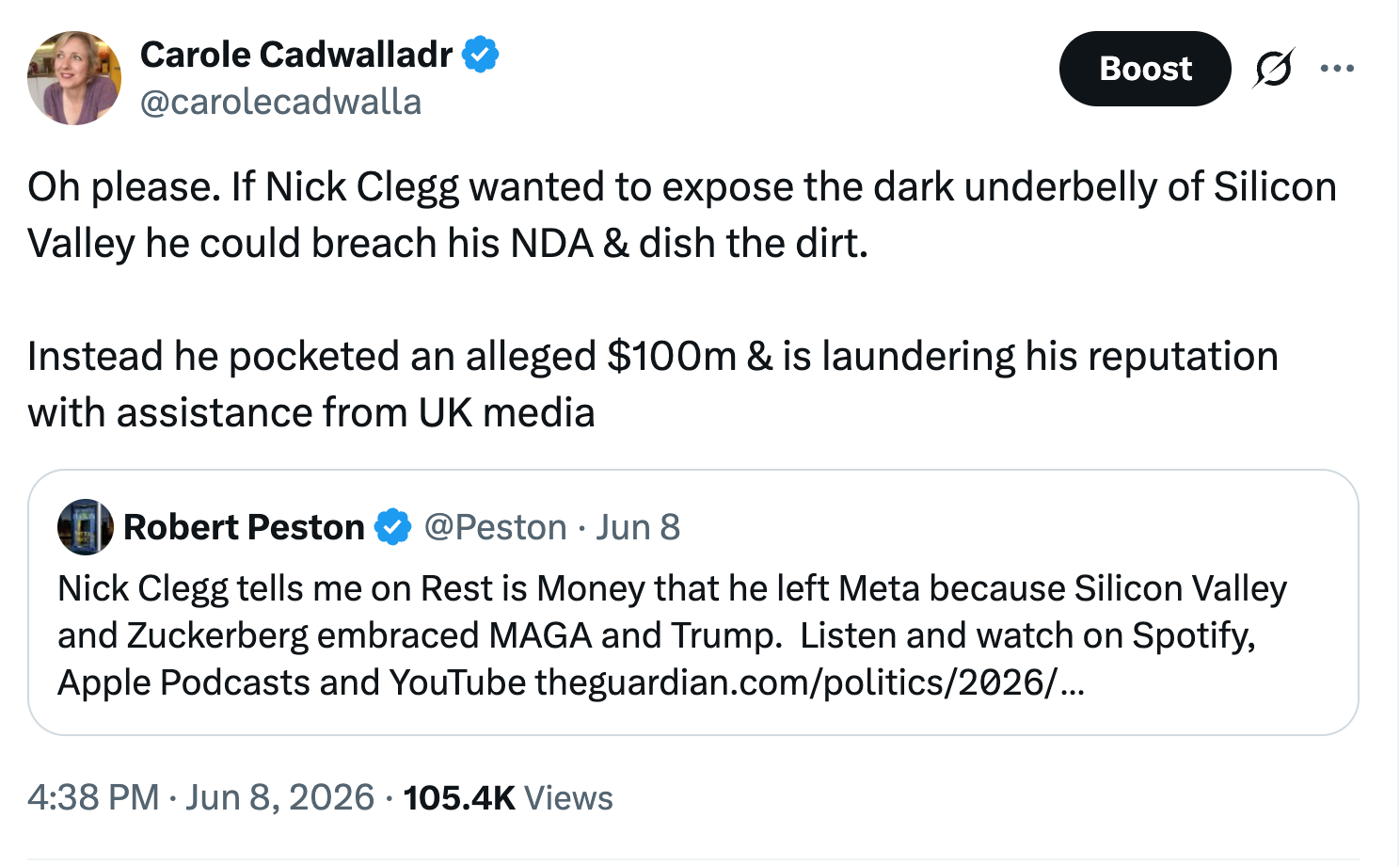
Clegg has signed exactly the same kind of severance agreement that Wynn Williams has. He’s not dishing any dirt because he’s been paid handsomely not to and because he’s still a believer. It’s preposterous that he’s treated as any sort of independent authority.
Tech companies use arbitration courts because they can. Just as they write the terms of service that we the users have no choice but to accept, they also write the contracts that employees must sign to take a job. It’s a legitimised form of corporate bullying, a non-state parallel justice system. And now one that Sarah Wynn Williams finds herself trapped in.
And it maps onto other networks, one used by criminals and gangsters. I found myself investigating arbitration courts, some years ago, when I was trying to understand why and how Cambridge Analytica was seeking to set one up in St Kitts and Nevis.
I never uncovered a definitive answer to that but I did speak to a lawyer who’d been involved in the scheme. What are some of the dodgier possible use cases of arbitration courts, I asked him. “Well, money laundering for one,” he said. It’s a simple matter to set up a fake arbitration to settle a fake dispute. Party A seeks resolution to a dispute with Party B, a judge finds in Party B’s favour and Party A has to pay them a load of cash. The money is legitimately washed through another company’s accounts.
Another scenario is where individuals use these courts to seize assets by illegitimate means. Nice company you keep, Facebook.
As chance would have it, I found myself on a call with another lawyer last week who’s an expert in these private arbitration courts. She had been following how the owners of Prospera - who include Peter Thiel - are trying to use them against the Honduran government.
Prospera is a fake country invented by tech bros. Prospera is a charter city or “Network State”, a libertarian experiment funded by a bunch of Silicon Valley VCs, in which a tract of land in Honduras became a test bed for their ideas without the interference of that annoyance that all tech bros loathe: government.
One of the investors in the project, Balaji Srinivasan, has written a book called “Network State” although he stole the concept from Curtis Yarvin, a cod-philosopher (who I wrote about here) who stole it from someone else. But then it’s neither clever or radical, it’s a trite cross between disaster capitalism and tech-utopianism in which instead of citizens, you have consumers and instead of an elected leader, you have a CEO. And instead of laws banning things like human experimentation - which has had a bad rap since Josef Mengele - you have a free market economy in which if someone is willing to be paid to be a human guinea pig for untested drugs, you can go right ahead.
There have been various attempts to create the cryptolibertarian dream and for a time, Prospera on Honduras’s Roatan peninsula seemed like it might be the most successful of these. But now, the new government has cooled on it. And this is where the arbitration court comes in, Prospera’s owners are attempting to heavy the government to do its bidding through this private, parallel, non-state legal system.
Meanwhile, as I said in the intro, Thiel’s attention has moved on to his next prey: Argentina. Why bother to go to all the effort of creating a new country when you can take over an existing one?
And Javier Milei is proving himself a willing ally. This is the op-ed that he wrote for the FT in which he framed lack of any regulation for AI as the latest, most logical evolution of the free market economy. (A free link here, also.)
And he writes about Argentina’s plans to create “the non-human corporation. These are entities operated by AI agents or robots”.
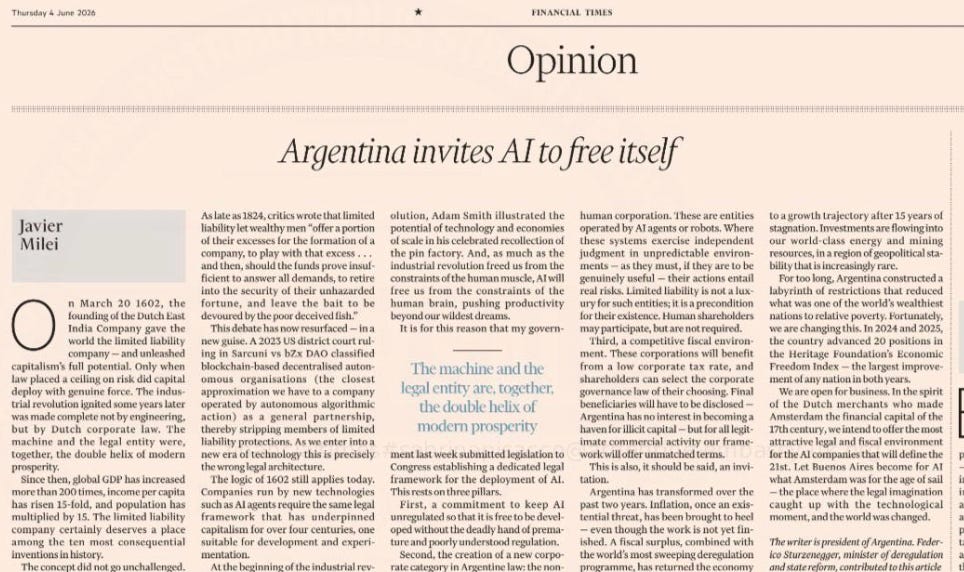
Argentina is Thiel’s petri dish. I fear he is looking for others too, including the UK. I want to write about how Britain is uniquely vulnerable among western nations to a corporate-style takeover of determined anti-democrats, our lack of constitutional protections makes us more vulnerable than almost any other country.
I’m not the only person to have noticed that. Far-right political podcasters have made similar observations with very different framing. The talk isn’t of danger, it’s “opportunity”.
More on that soon. In the meantime here is Argentinian reporter Uki Goñi, on his observations on Thiel’s Buenos Aires residency:
“In 1977, Argentina’s dictatorship recorded my phone conversations. That required plainclothes men manually connecting a tape recorder to the phone wiring on the roof of my apartment building. I ran into them trotting down the stairs a couple of times, spools of recording tape snaking out of their leather satchels.
“I had just started working at the newsroom of the Buenos Aires Herald, a small English-language daily that was the only one in Argentina reporting on the thousands of “disappeared” victims of the dictatorship.
The recent move of Palantir co-founder Peter Thiel and his family to Argentina has revived this painful memory of being spied upon. ln April, Thiel met with Argentina’s “anarcho-capitalist” president Javier Milei, who claims to be waging a “culture war” between “the forces of heaven” and “communism”, echoing the speeches of Argentina’s 1970s generals.
“I wondered about two things in the 1970s. First, could an Argentine-style oligarchy stage a coup one day in the US, the country where I had been born and raised? Second, would authoritarians of the future still need to manually transcribe endless hours of phone calls?
“Following the return of democracy I started writing books on these topics and interviewed some of the Nazis who escaped here after 1945. These Germans shared Argentina’s trans-generational belief in a “culture war”, only that in our 21st-century version, at least so far, it has not led to mass murder.
“The visitors from the US were David Rockefeller and Henry Kissinger back then, empowering and emboldening Argentina’s conspiracy-minded authoritarians who saw an “enemy of western and christian civilization” behind every signpost.
“I can’t help but wonder what a new generation of wacko authoritarians could achieve, freed by the digital tools we now possess from lugging around spools of recording tape to monitor their prey.”
Me too.
Finally…
I’m hosting an online event on Tuesday, organised by the Citizens and Volt Europa, on the “Hostile Takeover of Democracy by Big Tech” and specifically about Europe’s urgent need for digital sovereignty and what that means. Subscribe here for a notification on when it goes live.
And do read my latest investigation in the Nerve. It’s the latest in our series, the Harborne Receipts, a focused, urgently needed deep dive into the crypto money flooding into UK politics through one man, Christopher Harborne. If you’re in the US, where the crypto bros were some of the biggest funders of Trump in the last election, you will know this playbook. Harborne is a cryptobillionaire who, according to legal filings, owns 12% of the so-called “stablecoin” Tether.
There’s a developing scandal in Britain - finally! - into the money behind Nigel Farage who failed to disclose a £5m gift from Christopher Harborne. In our investigation yesterday, we reveal that Boris Johnson also failed to reveal a gift from Harborne of private jet flights when still an MP two months after giving him a personal gift of £1m.
And none of that even touches the sides of Tether which is embroiled in multiple political scandals across the pond. If you want to get into that, start with Howard Lutnick, friend of Donald Trump and Jeffrey Epstein who Senator Elizabeth Warren is trying to investigate. She describes Tether as “a foreign company whose stablecoin has been used to finance illicit activity around the world”. Its involvement in US politics is, she says, a threat to national security.
I’ll end it here. Crypto, Prospera, Argentina’s AI bill, the silencing of a whistleblower, it’s all of a piece, a shift in power structures that is tending away from the nation state towards a post-state reality owned and run by a group of men who believe they are more powerful than gods.
This is what we’re up against.
PS: There’s someone else who I think signed a joining agreement when they went to work for a Silicon Valley company. Someone who is now working in one of the most important roles in British public life. Someone who is now responsible for a partnership with that Silicon Valley company but won’t say if they’re constrained in what they can or cannot say about it: Matt Brittin, formerly the head of Google Europe, now the director-general of the BBC.
The BBC’s press office is simply refusing to answer my questions on this although the BBC’s partnership with YouTube, means it’s a potentially horrible conflict of interest. Like Clegg, what’s perhaps most egregious of all about these contracts is that their terms and conditions are private. Individuals come out of these companies and it’s not just that they guard their secrets and don’t criticise them publicly, we simply don’t whether they are constrained under what terms and under threat of what penalties, having taken what inducements. It’s an invisible form of control that creates a class of people influencing our public life while still in thrall to these companies.
Carole, you are amazing
This really resonated with me, Carole.
I'm deeply frightened by the growing influence of billionaire tech bros, the erosion of democratic norms and the way authoritarian ideas now seem to travel so easily across borders. We can all see the networks forming, the conferences, the messaging and the attempts to influence democratic countries, including here in the UK.
But then I think of Hungary.
For years it looked as though Viktor Orbán had made himself politically untouchable. He changed the rules, dominated much of the media landscape and seemed to have every structural advantage. Yet Hungarian voters proved that no leader is invincible forever when there is a credible alternative and people refuse to give in to despair.
Perhaps that's the lesson. We should be worried. We should stay informed. We should support independent journalism (like yours), engage in our communities and defend democratic institutions. But we mustn't surrender to fatalism. Fatalism is exactly what those who seek to concentrate power would like us to feel.
Thank you for continuing to shine a light where so many others won't.