
On Power
Liminal thoughts from a liminal space, "The Perineum" between Christmas and New Year

Hello from deepest, wildest west Wales in what a friend of mine calls “The Perineum”: aka the thin membrane of time between the twin peaks of Christmas and New Year. Normal service is suspended, the old year is ended, the new one is yet to begin…
I launched this newsletter in November 2024 in the week that Donald Trump was re-elected. Everything I’d been warning about for a decade was coming to pass, but I was energised. Reporting on information warfare had made me a target of information warfare which in turn had made me an expert in information warfare, in fighting back. And at least now, finally, the threat was visible.
A few weeks later, I distilled some of that experience into a Guardian column headlined “How to survive the Broligarchy: 20 lessons for the post-truth world”.
I’m going to re-visit that column - and where we are now - in the next newsletter because when I wrote my original column, it was a prediction of what was to come. And now it has, just faster than anybody thought.
But this week, walking the dark, secret valleys of deepest west Wales, I wanted to look back before looking forward. Reculer pour mieux sauter, they say in French. Step back to jump better.
This time, a year ago, I had no idea I’d be returning to TED, the place where in 2019 I gave another TED talk that led to a debilitating lawsuit. And I can see that from the outside, it might seem like some sort of pre-ordained success. But it wasn’t a pre-ordained anything.
And neither is what happens next.
The precipitating incident
In the first week of February, I went out for dinner to celebrate the release of the first episode of Stalked, a BBC podcast series I’d made with Hannah, the daughter of my ex. She was the central character in the podcast and it was a big deal: a highly personal story of how she’d been groomed and then targeted by a stalker.
It had taken us nearly four years to make and was only possible because of the extraordinary diligence and care of a BBC producer called Georgia Catt. She had guided Hannah through it as she opened up her entire life to scrutiny. But now, Hannah was giddy. “I just feel so light,” she said.
We didn’t know where the story would lead. How the man we’d named would react. What would happen. He’d hired an expensive London libel lawyer and had sent repeated letters denying all claims.
But she wasn’t hiding any more. The shame and isolation had gone. She’d reclaimed her life, her story, a story that one in five women will experience in their lifetime. We toasted that and back home I doomscrolled the news and then my emails.
It was February, 2025, Elon Musk had just performed not one but two Nazi salutes at an inauguration rally and DOGE was breaking and entering into government offices to gain unlawful access to data. And TED had sent me an excitable marketing email about Sam Altman as a headline speaker in their upcoming conference.
I hit reply and tapped out an email on my phone. “You will have the bros and that's as it should be,” I wrote to Helen Walters, the senior TED curator whose name was on the email. “But you also need the voices who will tell people how to navigate this shit.”
Forty-eight hours later, she emailed back: Come.
Into the lion’s den
I didn’t reply to the email for days.
I hadn’t expected her to say yes and although I understood why I should go back - it was why I’d sent the email - I didn’t know if I could go back.
Another story: six months after my trial in the High Court in 2022, my editor invited me to a meeting at the Guardian offices.
Walking through the lobby with the posters on the walls about speaking truth to power, up the escalators, into the glass and steel heart of the building, I just had what felt like an out-of-body experience. The office was a corporate projection of money and legitimacy and authority, a symbol of the Guardian’s institutional power and importance..that just hadn’t been there for me.
Its decision to not support me in the lawsuit ultimately caused me more distress and anguish than the lawsuit itself. It wasn’t the bad guys going after me that I found so debilitating. It was the good guys not sticking up for me. I said nothing in public because I already felt so weak and exposed. To acknowledge that publicly, would only have made me more so.
I’ll spare you the details of what happened next, for now. It was, I learned afterwards, a classic PTSD episode. I’d had a similar experience right after my trial but this was six months on. It was meant to be over and it wasn’t.
I’m telling this story because this TED talk is not another data point on an upwards trajectory of what from the outside could seem like validation and success. That’s not what it was. I communicated fear in that talk because that talk came from fear.
The day before
I wrote a draft. And then, after feedback, another one. And then a third. The day before I was due to fly out, they came back a final time, Chris Anderson, the head of TED, was summoned. It still didn’t work, he said.
Chris ripped into the talk, challenging me on multiple points, the final one of which was “Do you have to mention the lawsuit?” he said. “It means nothing to this audience.” It means something to me, I said and I burst into tears. I fought for years to defend the facts, I said. They matter to me.
“Look,” said Chris, softening. “These are suggestions. We invited you. It’s up to you what you say.”
That night, I went to the leaving party for the staff of the Observer. In the midst of the political tumult of Trump’s re-election, we’d dealt with our own internal tumult: the oligarchic capture of our newspaper. I can’t describe it in any other terms. We were being “transferred” from a non-profit to a private owner, backed by a group of investors some of whom they’d refused to disclose.
The party was a strange, bittersweet affair. Some of my colleagues were going, others - including me - weren’t. We’d needed a spokesperson and I elected to be it. It had been my choice. I didn’t regret it. But two weeks earlier, the new management had written to me: they would not be offering me a new contract.
The next day, I flew to TED.
Miss Shaky Hands
At the dress rehearsal, I physically trembled throughout. “Alright, Miss Shaky Hands,” said Helen at the end of it.
I should have spent the next morning learning it. It’s drilled into you that you need to know it word for word - you’re delivering it to 1,000 people with no notes, under the pressure that it’s going to live online forever. Instead, I spent it filling out a multi-page form in a last-minute attempt to get professional indemnity insurance.
But to do so, I needed the sign-off of a UK media lawyer. I emailed Tamsin Allen, my go-to expert. She knew the story back to front.
There’s no completely safe way you can talk about the case at TED, she told me. It’s not any one thing: it’s that it’s you and it’s TED and it’s this person. There’s a risk that couldn’t be underwritten away.
I didn’t get the insurance.
In 2019, I’d had a full-on panic attack right before I’d gone on. The stage manager had handed me a brown paper bag and I’d stood in the wings breathing in and out of it, my heart pounding in my chest. This time around, it felt more like going out to face a firing squad. I felt total resignation.
But also power. In the front row, was a full complement of Silicon Valley bros. Or as I got to call them, data rapists and collaborators.
You have more power than you think
I wasn’t sure when I began why I was writing this. But so many of the comments beneath the video on YouTube say how terrified I looked. And here in the perineum of the year, all I can say is that as fearful as I was, I am genuinely more fearful about what lies ahead. Everything I’ve feared would happen is happening.
America has fallen. NATO is teetering. Europe is on the brink of some new darkness. The Silicon Valley tech companies are now in an alliance with the worst people on the planet. But Hannah taught me a lesson. And I tried, as best as I could, to carry that forward. This newsletter is dedicated to the memory of Virginia Giuffre. It’s only because of people like her that journalists can do what they do. She shone a light in the darkness.
We have more power than we think. That’s the key line from the talk. Nothing is pre-ordained. We get to decide what happens next. But I didn’t know that, until I proved it to myself. And maybe the real reason why I’ve written this today is that there is at least one person out there who needs to hear this. I hope it finds you where you are.
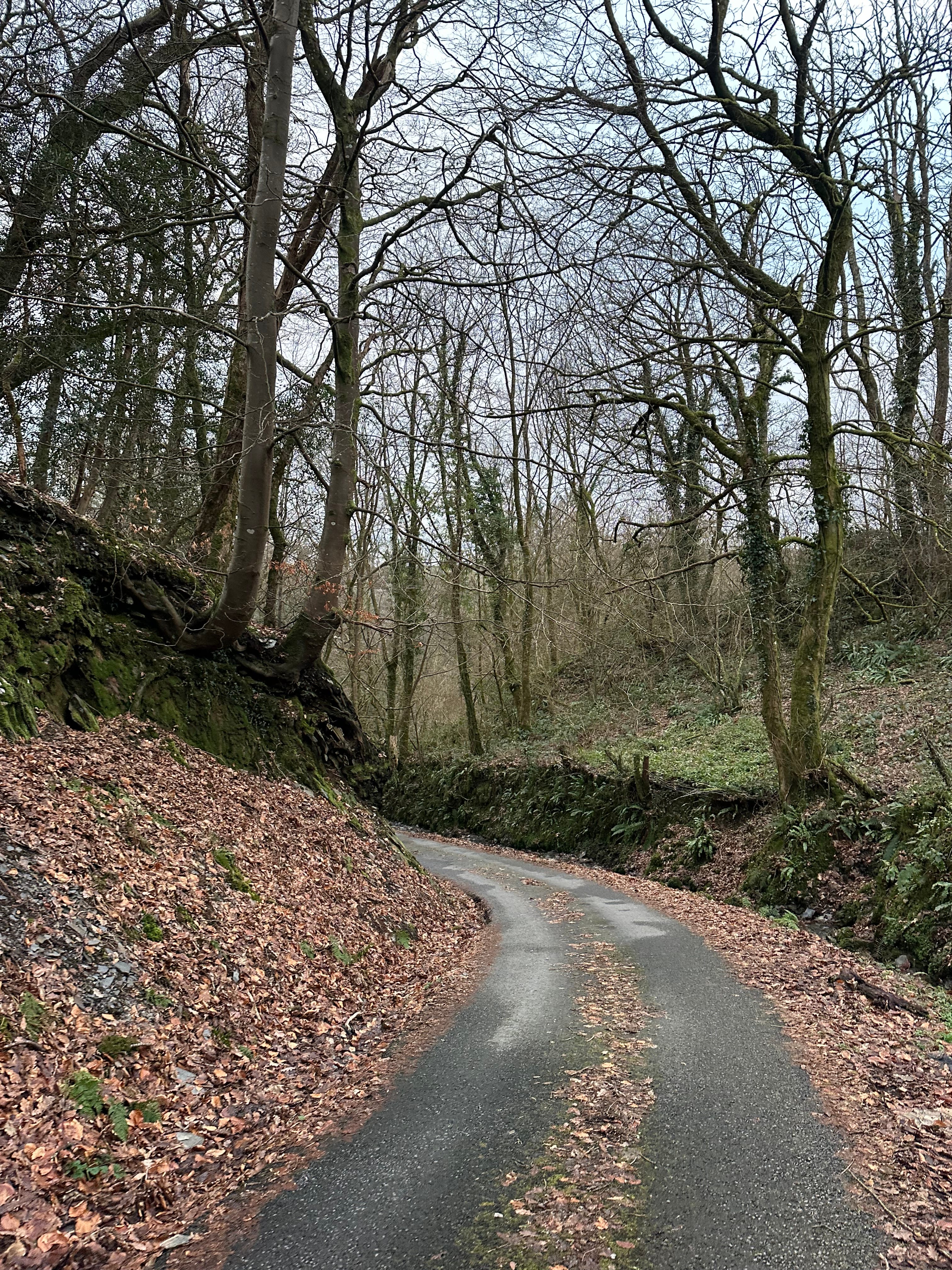
PS This is what a road through slice of lost rainforest in a hidden Welsh valley looks like. I’ve since discovered it’s the entrance to the Annwn in the Mabinogion, the earliest Welsh prose stories, an “Otherworld”, a place beyond mortal understanding. Which sounds about right to me.
See you in the new year x
Thank you for putting yourself in the firing line on behalf of us all. Deeply grateful and humbled.
Thank you for your courage, for speaking truth. You are a beacon.