
Fight!
Fuck Bezos. The Washington Post can and must rise again.

A note on who I am: I’m an investigative journalist who’s spent a decade reporting on the collision of technology and democracy including exposing the Facebook/Cambridge Analytica scandal for the Guardian and the New York Times. Two years ago, I called the alliance of Trump, Silicon Valley and a global axis of autocracy: a tech bro oligarchy, aka the Broligarchy. Please help me continue to expose it.
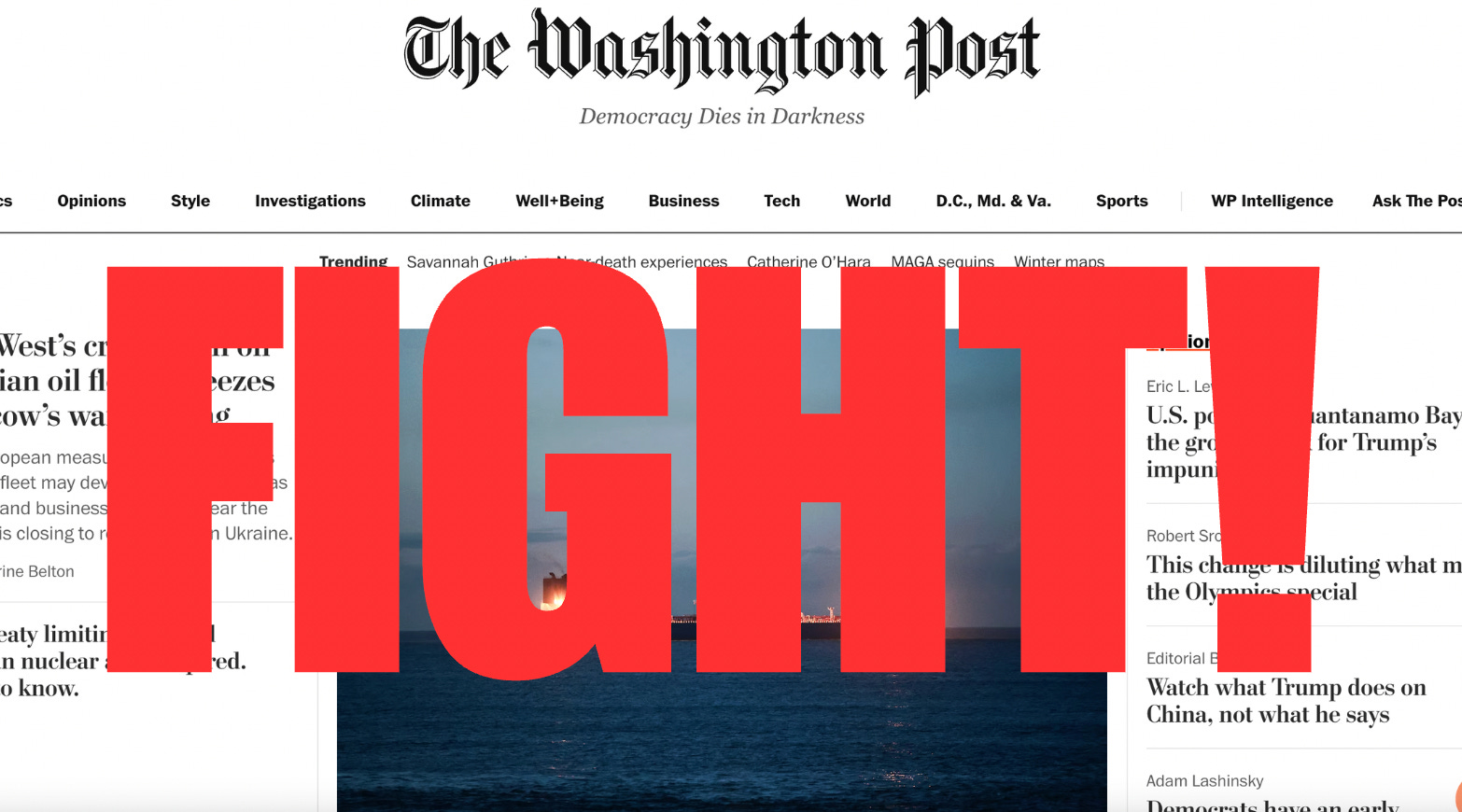
This is a quick newsletter to republish a piece that I’ve just written for Press Gazette, a UK-based trade mag for the media industry. I’ve been trying to write a complicated piece about Epstein for the last four days and what the files reveal about his relationship with the Kremlin and Silicon Valley and hopefully I will get that out tomorrow. But I’ve distracted by some distressing news in my world of journalism and I wanted to post about it here.
Yesterday, the Washington Post announced it is “laying off” 300 journalists, ie sacking them. It’s devastating for the individuals, for the Washington Post, for America and, given that so many of them were foreign correspondents, the world.
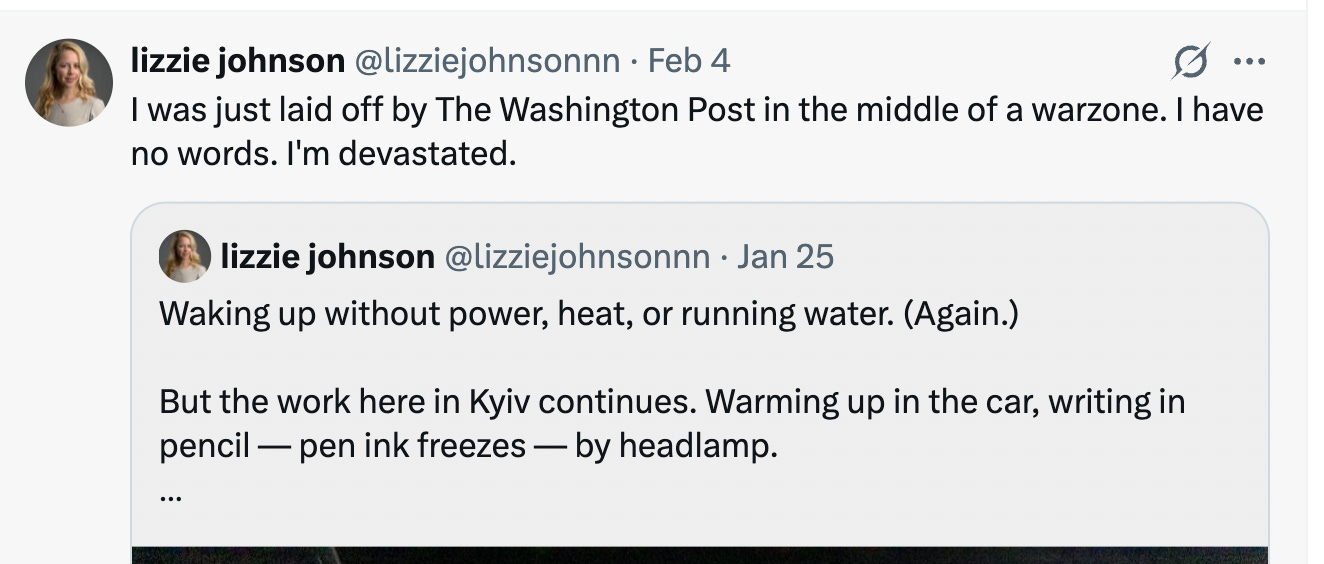
Last night, I saw a deluge of tweet after tweet from brilliant and dedicated Washington Post journalists, editors, photographers. From the war reporter sacked while in a war zone:
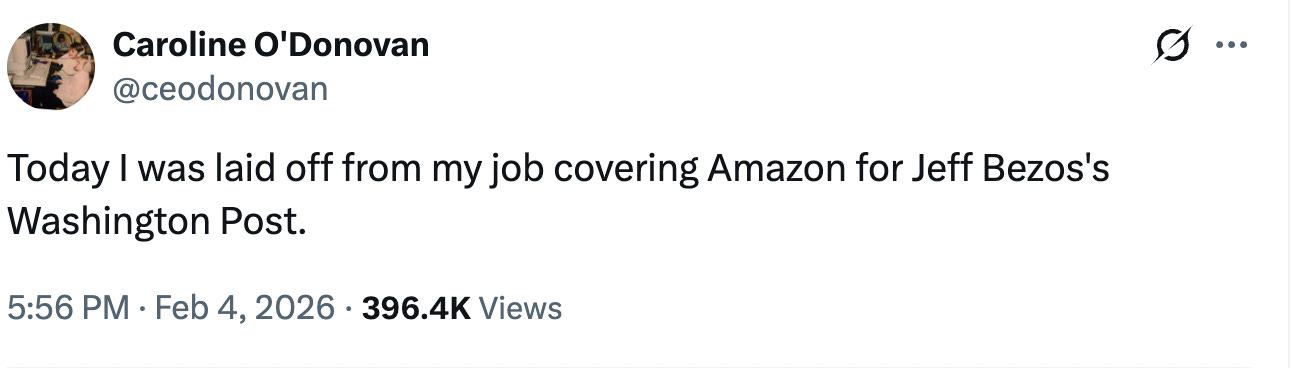
To the reporter whose job it was to track Jeff Bezos’s business interests:
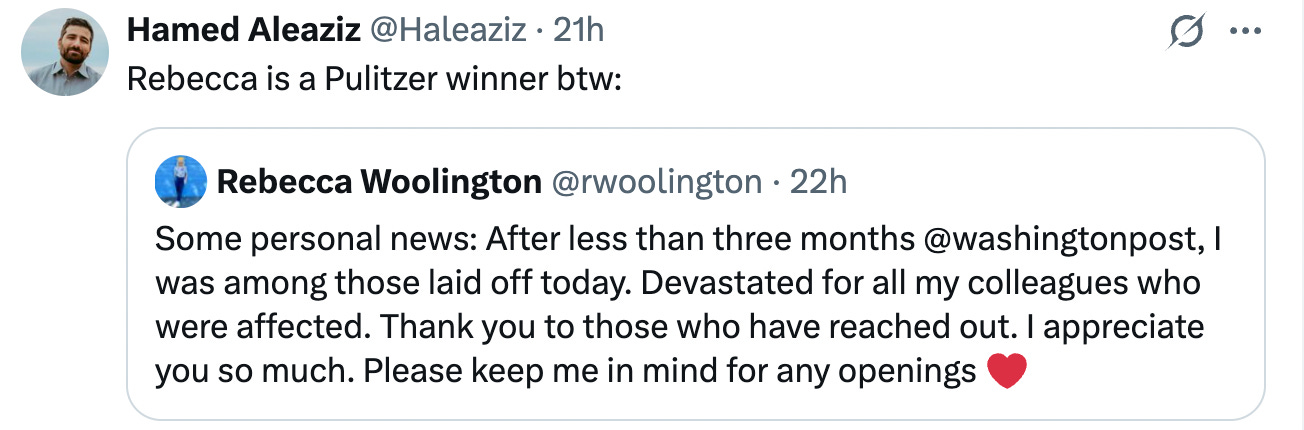
To Pulitzer prize winners:
And many many more.
This is entirely down to the actions of Jeff Bezos, a tech fuck boy* who’s completely surrendered to a would-be dictator. His decision to not endorse Kamala Harris and then cleanse the opinion pages of any dissenting views caused a collapse in reader revenues. Now, his whipping boy, Will Lewis, a Brit schooled by the OG of the political-media dark arts, Rupert Murdoch, has purged the news organisation of its most vital resource: journalists.
(*Am pleased with this new term, feel free to “broligarch” it up.)
This is a bloodbath. The purging of 300 journalists from one of the most important news titles in America is an incalculable loss.
This kind of institutional knowledge and infrastructure has been nurtured over generations. And now it’s gone. The DNA of Watergate has been passed down to the present generation of journalists. During Trump 1, it coined its “Democracy Dies in Darkness” slogan and did the hard yards of trying to hold the administration to account.
What I can’t actually believe it has the barefaced gall to still have that phrase on its masthead though I liked this take from the Reductress, titled: The Washington Post Lays Off Half Its Slogan.

I bashed out a series of tweets when I saw the news because I know exactly how these journalists feel: sad, betrayed, angry, uncertain what the future holds. It’s exactly what happened to us at the Guardian less than a year ago. In our case, it was down to the actions of an unaccountable executive management team but the effect was the same.
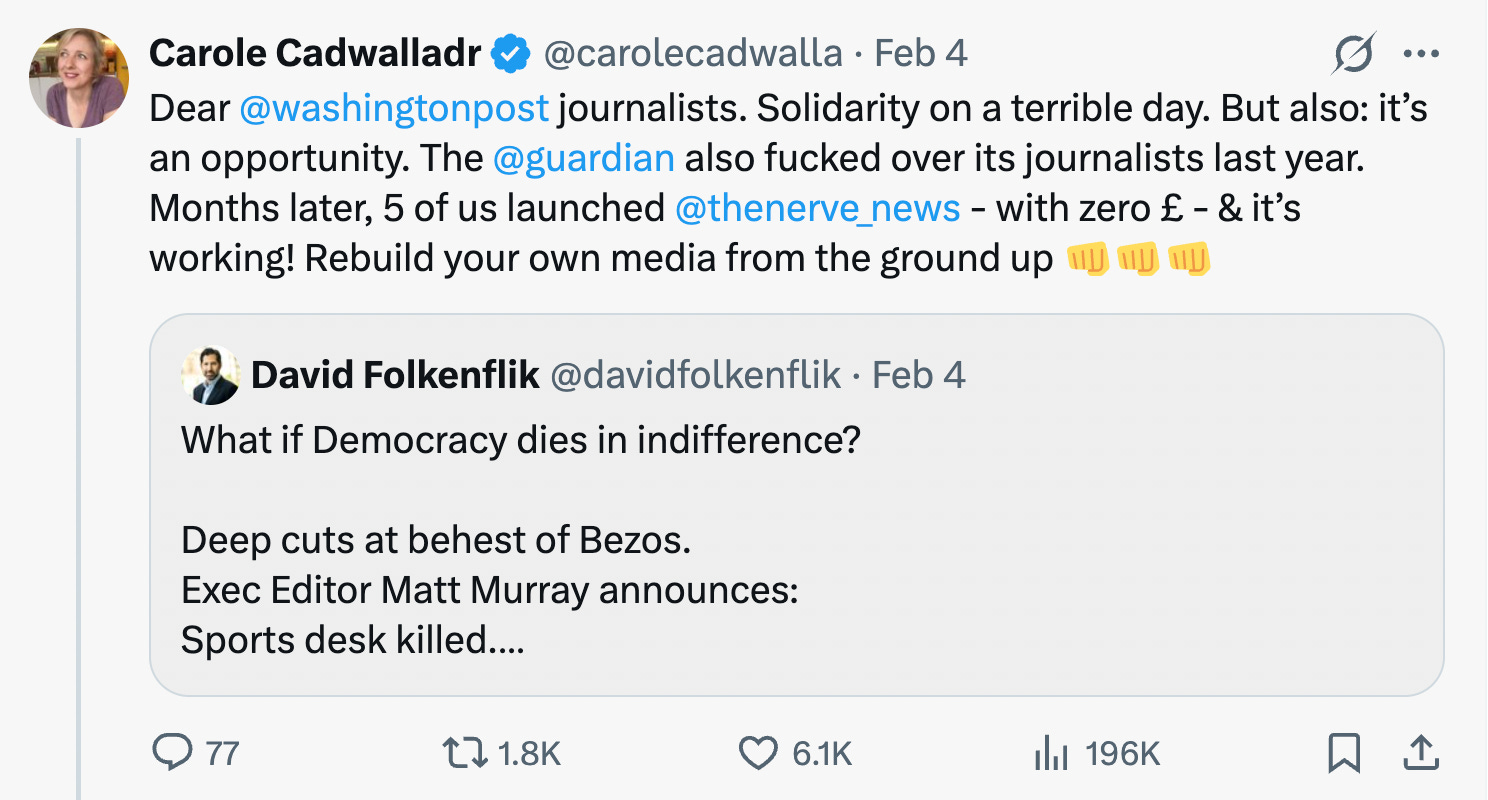
Anyway, I expanded that out today as a letter to the 300 sacked journalists for a piece for Press Gazette.
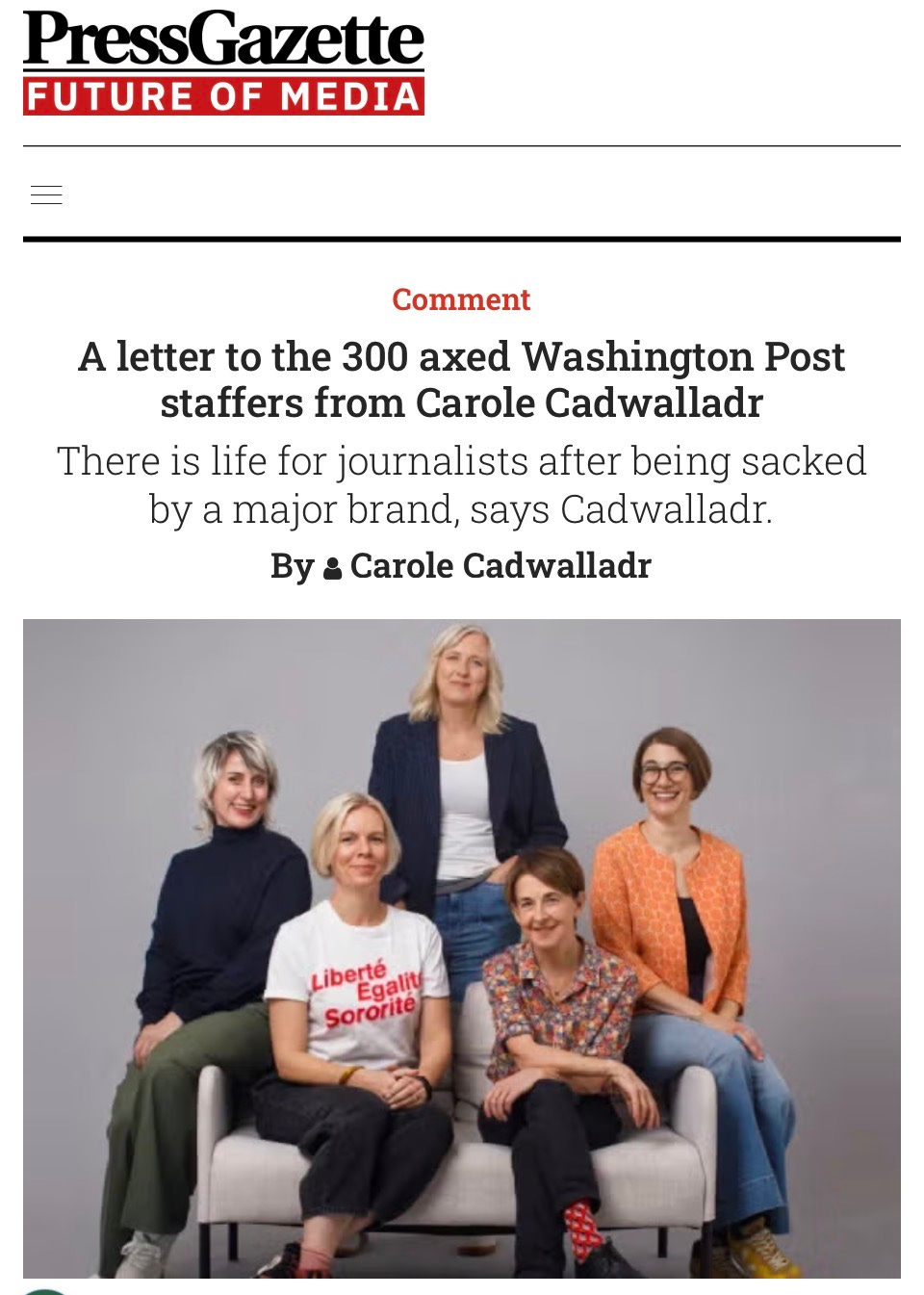
I’m going to reproduce that below. And underneath that I’ve pasted the Nerve’s latest deep dive into Peter Thiel’s Palantir.
But I’ve interrupted my other work to write about the Washington Post because the attack on press freedom is central to everything we see happening right now. It’s not a coincidence. Trump’s US coup is already in its advanced stages. And what is very certain right now is that the billionaires aren’t going to save anyone. But journalists can and must save themselves and the one thing that I wanted to communicate to Post journalists is that they are not helpless.
I’ve experienced not just an attack on press freedom, but a direct assault. For a long time, it was all I could do to survive it. But that’s also how I learned how to fight back. And that’s the number one point I want to communicate right now. I wish their colleagues still in position would take collective action while the US still has labor laws that mean anything at all.
As I write in the piece, the experience of going on strike was foundational to what we did next step in setting up our own news outlet. Action is agency. And while I’m sure there will be big ticket efforts to start something new from the wreckage of the Post funded by big league Democrat funders (I certainly hope so),but my message is that you don’t have to wait for the cavalry to arrive (not least because they may not come).
When this happened to us at the Guardian, I spoke to a lot of clever people about my next journalistic step. The no-brainer step for me, they said, was to focus on this newsletter and “build out” a brand. Instead, I took another route of joining forces with other journalists - experienced editors and a designer - because I still believe that journalism is a team sport. And you have to start somewhere.
From today’s Press Gazette: A letter to the 300 axed Washington Post journalists
Dear Washington Post journalists,
Solidarity on a terrible day. A craven tech bro has sold you out.
The Post is a symbol, both for journalism and America, and for Jeff Bezos and Will Lewis to axe 300 of you in a single day, including those currently reporting in war zones, feels like an augury.
But as a journalist who worked for the Guardian for 20 years and who, alongside my colleagues, was binned in a similar fashion less than a year ago, I have important information to impart: do not give up.
When our management decided to dump our beloved newspaper, The Observer, we, as a news organisation, fought back: we went on strike. We didn’t win – a board of mainly non-journalists led by a banker saw to that – but we went down fighting. It isn’t over until it’s over.
One week after 100 staff and freelance journalists were “banged out” of the Guardian’s offices (an old Fleet Street tradition, don’t ask), we started planning a phoenix project. What if we set up our own news outlet? Was that even possible?
[The Observerwas taken over by Tortoise Media Group in March 2025with at least 20 staff taking redundancy and many other long-serving freelances and casuals, including Cadwalladr, losing their jobs]
We were inspired by a crop of insurgent new outlets in the US (Zeteo, Drop Site News, The Contrarian, 404 Media, Status) and the UK (Byline Times, DoubleDown News, Declassified, Mill Media). And, also by the sense of agency that came from going on strike. Standing in solidarity for the journalistic values we believed in and having a laugh in the process was the genesis of the idea for what became The Nerve.
What if we could try to do journalism in a different way? What if we didn’t have to ask permission? What if we could persuade a community of readers to build a new kind of journalism with us?
“We” are three senior editors. Jane Ferguson, (the former editor of the Observer New Review section), her deputy Sarah Donaldson (who’s leading the project), Imogen Carter (another senior editor), The Observer’s former creative director Lynsey Irvine and me, an investigative journalist and writer.
At the time, we assumed we needed money and investment. That’s what everyone told us. Especially as I was the only writer and we had ambitions: for meaty investigations, for public interest reporting, for reviews by great critics, and to pay the paper’s two most popular columnists – Stewart Lee and Philippa Perry – who’d elected to come with us.
But in the end we opted to simply just jump off the cliff. Our USP as a team is that we know how to execute – we’ve worked together for nearly 20 years – so that’s what we did. The others invested their Guardian payoffs in the project and I was being supported by a Substack newsletter I’d hastily set up. We started with nothing.
It’s why we chose the name, The Nerve, because you can’t tell people to have nerve unless you can show it yourself. And having nerve we believe is the quality, more than any other, that’s needed right now.
So, here’s how it’s going. We focus on what we believe are the three subjects that define our age: culture, politics and tech. We produce two beautifully curated newsletters a week, a website, thenerve.news, and a newly launched YouTube channel
We don’t paywall but we offer membership benefits with live and virtual events.
We bust our three-month target in the first week.
We’ve landed several major investigations (a whole run of stories on a Russian spy ring, Larry Ellison’s capture of Tony Blair and Palantir’s dangerous enmeshment in the UK state).
We’ve published a pilot print product. Our Bluesky already has four times the followers (17,000) of our old newspaper. Our Instagram posts reach up to half a million people. We’re paying for everything out of revenue. We’ve now received grants from two incredibly generous philanthropists to support our expansion into video and public interest investigations. And if we can maintain the same, modest rate of growth, we will be sustainable in a year.
For the number nerds: our monthly growth is in double digits. Our conversion rate (free to paying subscribers) is 12% – three times the industry standard of 3 to 4%. And the open rate of our newsletters is an incredibly high 60%.
I was a Guardian lifer. I would never have given up the reach of a global news platform. For the last decade, I have worked flat out to expose what I hope everyone can now see is a Silicon Valley-enabled global far-right insurgency. And what’s mattered to me more than anything is for that work to have impact.
And here’s the most stunning finding to report. Between the Nerve and my personal Substack – How to Survive the Broligarchy, which is just over a year old – I get up to 200,000 unique views per article. To put that into perspective, it’s what the very best performing stories on the Guardian’s website get outside breaking news.
We’re only four months in and it could all go horribly wrong but speaking personally I don’t care. The world is on fire. The entire media industry is a shitshow. And the only interesting, impactful thing to do in this moment, I believe, is to be bold and brave and to try something new.
What looks like “security” isn’t. If a news organisation decides to dump an entire title or a broligarch can axe 300 journalists in a single day, it’s not any sort of sustainable or reliable model.
You can’t rebuild the Washington Post overnight but you can try. Beehiiv, the newsletter platform we use, put us on their media collective programme which includes paying for our monthly legal cover (in the US it also provides a medical insurance stipend). Mostly, we’re excited and proud to be part of a growing independent network that’s led by journalists and that understands why a free and independent press matters now more than ever.
To the battered and bruised journalists of the Washington Post, I have this to say: democracy doesn’t have to die in darkness. There is another way.
Your ally in arms, Carole
PS If you do want to take the leap, get in touch: carole.cadwalladr@thenerve.news.
Palantir update
Here as promised is the first piece I wrote on Palantir, last week for the Nerve. It was a deep dive into Palantir’s contracts with the UK government and new revelations about its total enmeshment in the UK’s critical infrastructure. It’s not just our National Health Service and the Ministry of Defence but also, wait for it, our nuclear weapons.
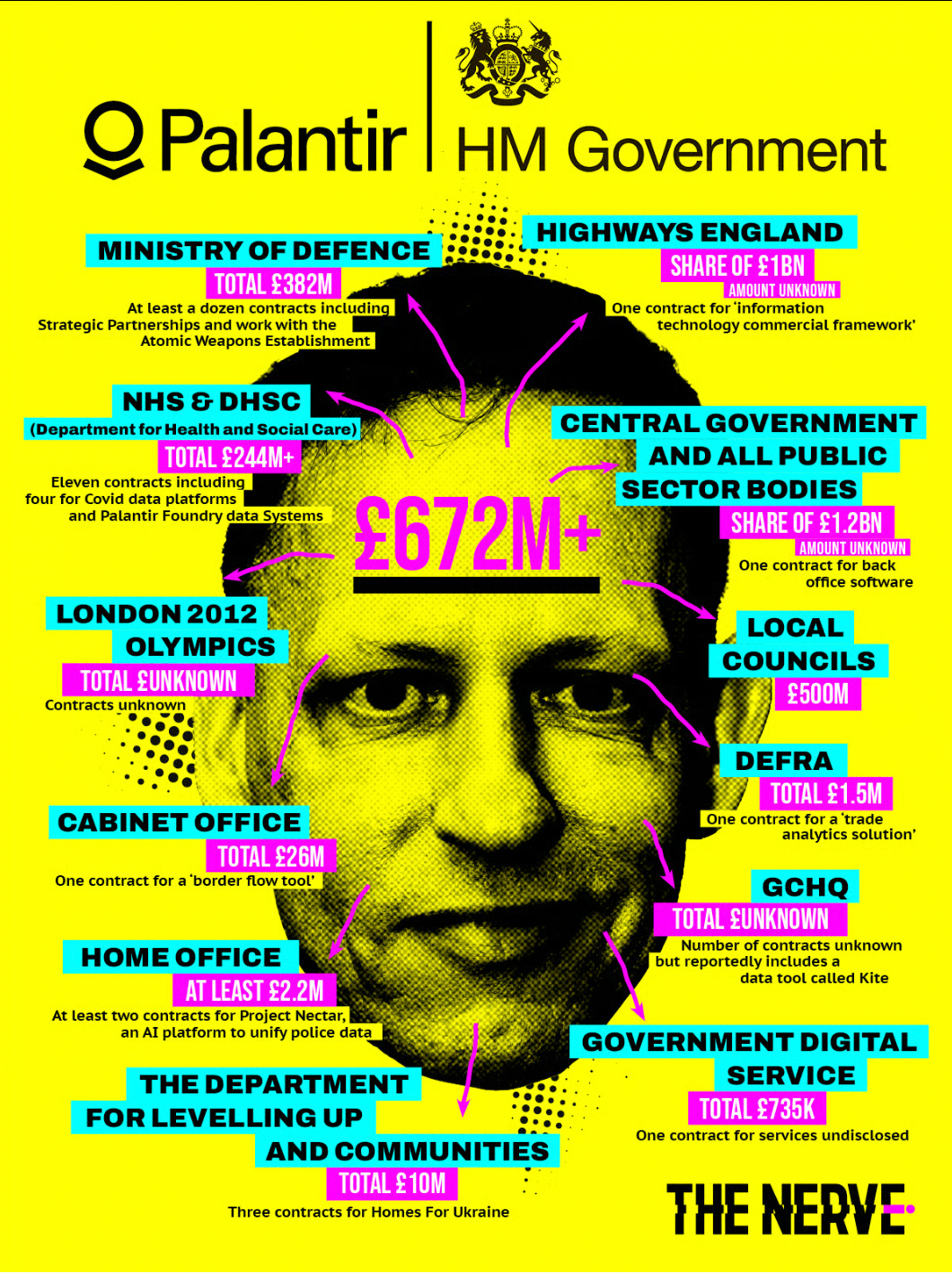
Peter Thiel is now centrally involved in what is supposed to be our ultimate deterrent. What could possible wrong?
There’s another piece I wrote last week which I’m going to come back to but one of the key points, for me, is that Palantir’s enmeshment in the UK is not just a risk to us - although it is - it also makes us complicit in what is happening in America right now.
The UK is Palantir’s second biggest customer. It’s activities are subsidised by nearly a billion dollars of UK taxpayers’ money. It’s a betrayal, I believe, of the American people.
We made a deliberate choice with the Nerve to focus on the three subjects that we believe are at the heart of everything that is happening right now: culture, politics and technology.
And Peter Thiel, embodies how those three subjects are not distinct spheres any more more than any other individual alive: They are one and the same.
I’m going to leave that here because Peter Thiel is right there in the Epstein files too and I want to get my interrupted piece out. The big scandal that’s roiled the UK press this week is the disgrace of Lord Mandelson who as well as being Jeffrey Epstein’s “best pal” was also…drum roll…Palantir’s lobbyist.
Keir Starmer made Mandelson his ambassador to Washington and when Starmer went to visit Trump last year, the only other visit he made was to Palantir’s office. That visit resulted in a £240m “strategic partnership” between the UK Ministry of Defence and, you guessed it, Palantir.
That visit was raised in a question in parliament yesterday. And that’s just the tip of decades-long iceberg.
The Epstein story is such a mess. I’ve been on the tech platforms-Russian interference-political manipulation beat since 2016 and it’s always felt like a relief when there are big stories that I can simply ignore. Epstein has been one of those. But no longer. That’s the piece I’ve been struggling to write. He’s right in the thick of everything I’ve been investigating and trying to expose for the last decade. What an absolute headfuck this week has been.
If you know any Washington Post journalists you know or follow, do share this piece. There’s no magic bullet right now and nothing can replace one of America’s most vital news organisations overnight, but repeat after me: the billionaires are not coming to save us.
To those who still do not subscribe to Carole’s scene get your wallet out NOW. This lady and her like are pivotal to us overcoming and exposing fascism, here in UK and Europe. I fear that battle already risks being lost in USA with its politically corrupt Supreme Court.
It's hard to watch as the Tech Broligarchy raze some of the US's most venerable media institutions but, given what's happening there right now - it's not unexpected. Large corporate media is (and I think, with a couple of exceptions, always was) beholden to the whims of its billionaire owners. However, as you're starting to prove with The Nerve, with disappointment comes opportunity. the future of independent and meaningful 4th Estate accountability is in new forms of publication such as the Nerve and Byline Times. Thanks Carole.